 Trigame
Tetgame Help
Tetgame is the 3D successor project growing from Trigame. This version keeps the help organized around a few large guidebook panels: The Board, Controls, Information, Procedure of Play, and Strategy. Each panel heading now includes small links to its sub-topics, so items such as Colors can live inside the Board panel without becoming another heavy bordered box.
The board
Start here: tets, sockets, tokens, paths, subs, full-tet capture, and player colors.
How to read this progression
These images walk through the early ideas of Tetgame in the same teaching order used by Trigame help. Begin with the shape of the board, then see where a token goes, how a path is captured, how chains can fill in more structure, how a sub is completed, and finally how a full tet is won.
- Tets are the 3D building blocks of the board.
- Tokens are placed on sockets.
- Paths are the connections between sockets.
- Subs are the smaller interior regions of a tet.
- Full tets are captured when the required subs belong to one player.
1) The starting board
The match begins from a very small board state. In this first image you can simply see the initial structure clearly before any further growth or capture is considered.

2) A tet
This image isolates a single tet so players can recognize its triangular faces, corners, center socket, and connecting paths. Understanding one tet makes the rest of the game easier to follow.

3) A token
A token claims one socket. Corner sockets are especially important because they influence multiple nearby paths and may also affect future tet growth.

4) A captured path between two tokens
When two same-player tokens occupy the ends of an adjacent path, that path is captured. This is one of the core ideas of Tetgame scoring.
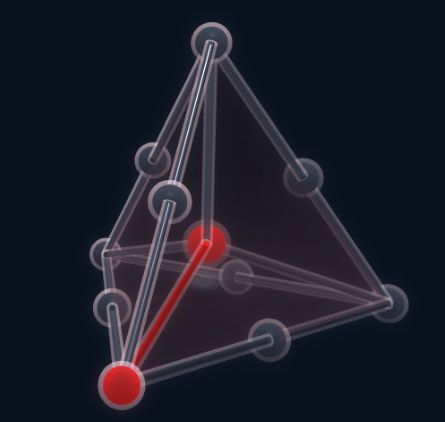
5) Paths and tokens captured between end tokens
Some placements do more than capture one short path. When the pattern is right, the game can auto-fill intervening sockets and award the linked path chain between matching end tokens.
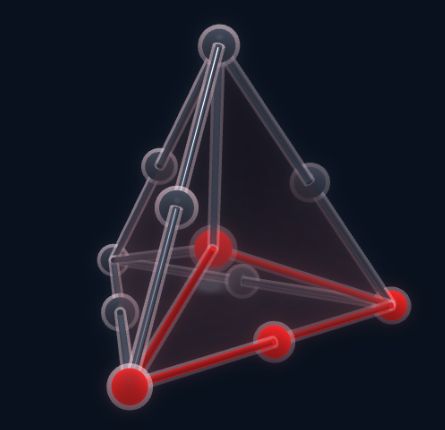
6) A sub
As more paths are captured, one of the smaller inner regions of a tet can be completed. That smaller region is called a sub, and it is worth points on the scoreboard.
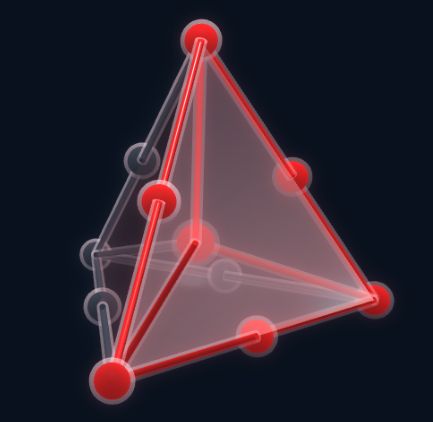
7) A whole tet
When the required subs of a tet belong to the same player, the full tet is captured. This is one of the larger scoring events in the game and a major strategic goal.

Player colors
Colors identify seats, tokens, paths, messages, and ownership.
Tetgame uses the same easy seat-color idea as Trigame. In larger games, colors also help make the communications panel and game record easier to read.
Ownership color
Owned paths, subs, and full tets should visually match the player who controls them.
System messages
Game/system messages stay white, while player chat and rabbot lines follow the player color.
Controls
Basic buttons, action modes, and view movement.
Players
Choose Practice or 2–6 contestants. Practice uses all six contestant colors in order.
Mode
Tet mode places or removes tetrahedrons. Token mode places or removes tokens on sockets.
Action
Place is the normal action. Remove is restricted and is only available under the rules below.
View
Use the camera with mouse or touch. The view buttons pan, zoom, focus, fit the board, or reset the camera.
Controls illustration

Information panels
What the side panels show during play.
Contestant
The Contestant panel shows the active roster, colors, names, human/rabbot status, and the visual identity for each seat.
Scoreboard
The Scoreboard panel tracks tokens, paths, subs, full tets, total score, and tournament points.
Turn
The Turn panel shows whose turn it is, which action they are taking, and whether they are on action 1/2 or action 2/2.
Communications
The Communications panel is for chat, game announcements, and rabbot voice/personality lines.
Game Record
The Game Record panel keeps the running move history, match notes, standings, and copyable tuning record text. It is also a compact language for describing where tets were placed or removed.
How the Game Record language works
The official move line uses short bracketed tet names. The colon is an event separator, not an equals sign.
The ghost tet is used as the human reference for the first orientation. Its four face views below show the starting face letters A, B, C, and D. Once the first real tet is placed, the ghost tet disappears, but its lettering still defines how tet names are built in the record.
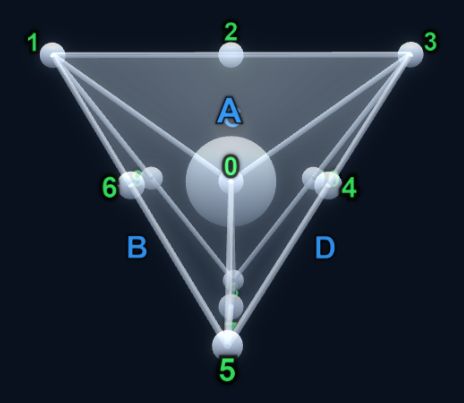

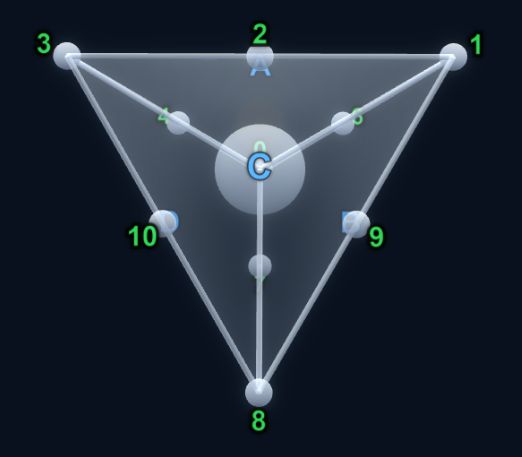
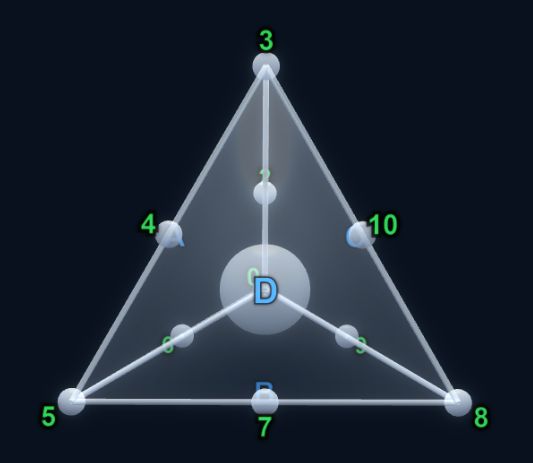
- [] means the original center tet.
- [A], [B], [C], or [D] mean a tet placed onto that named face of the original tet.
- Longer names continue the same way. For example, [AC] means “the tet placed on face C of tet [A],” and [ACD] means “the tet placed on face D of tet [AC].”
- A leading minus sign means removal. For example, -[AC] means the tet named [AC] was removed.
- Two actions on one turn are written on one line with a colon between them.
Read the example as three turns. On turn 1, player 1 places the original tet [] and then places tet [A]. On turn 2, player 2 removes [] and then places tet [AC]. On turn 1 again for the next round, player 1 places [AA] and then [AD].
This naming system lets a tet keep the same identity even if nearby tets are later removed. The board may change, but the recorded tet name still tells you how that tet originally entered the vine.
Scoring columns
Scoring belongs with the information panels because it explains what the Scoreboard is showing. The current columns are:
| Column | Meaning | Value |
|---|---|---|
| A | Tokens | ½ point each |
| B | Paths | 1 point each |
| C | Subs | 2 points each |
| D | Full tets | 5 points each |
| E | Total | A + B + C + D |
| F | Tournament | Tournament point total |
Procedure of play
The turn rhythm, placement rules, capture rules, and removal limits gathered into one play-procedure panel.
Turns
Each player normally gets two successful actions.
Turn clock
The clock in the Turn panel shows the current contestant and whether they are on action 1/2 or 2/2.
Two actions
Each contestant gets two successful actions. After the second action, play advances to the next active contestant.
Remove timing
Remove is only allowed as the first action of a player’s turn.
Placement
How tets and tokens enter the board.
Tet placement
A new tet must be placed face-to-face with an existing tet. Hovering over a valid face highlights it.
Blocked faces
A tet may not be placed against a face that already has a token on any of that face’s sockets.
Token placement
In Token mode, hover or select a socket and place a token there for the current contestant.
Overlap
When a new tet is placed against a face, the common face paths and sockets are claimed by the newly placed tet’s contestant color.
Capturing
Tokens lead to paths, paths lead to subs, and subs can lead to full tets.
Adjacent path capture
If two same-player tokens occupy the ends of an adjacent path, that path is captured.
Long path chains
Same-player tokens at opposite ends of a mostly straight chain can auto-fill the intervening sockets, but only through paths owned by that player’s tets.
Sub capture
Captured paths can claim smaller interior tetrahedral regions called subs.
Full tet capture
When the required subs of a tet are captured by the same contestant, the full tet is counted for that contestant.
Remove
Removal is possible, but deliberately limited.
Locked board
Remove is disabled when the board is locked.
Removing a tet
A tet may be removed only if it has no tokens on it. Removing a tet exposes its common face on the adjacent tet for future overlap.
Removing a token
A token may be removed only if it is not part of an owned or captured path.
One-time removal rule
Any particular tet, and any particular token location, may be removed only once per match. This prevents players from repeatedly bouncing back and forth by removing and replacing the same strategic piece.
Strategic result
Removing a tet may reopen a common face, allowing later placement and recapture through the overlap rule. Removing a lone center token can also change future capture opportunities.
Strategy notes
Early observations from current testing.
Placing tets is powerful
If one player keeps placing tets while the other mostly places tokens, the growth player usually gains more territory, more overlap chances, and more ways to score.
Center sockets can swing the game
Control of a central socket often determines who can complete subs and eventually full tets for large points.
Corner blocking
A single corner token blocks tet growth on three sides of that tet. In the right corner—especially opposite the joined face—it can completely stop further growth from that tet.
Capturing from corners
Even without the center, a player may still gain value by taking corners that complete owned paths or set up later sub captures on their own tets.