Welcome to the Warren

Trigame

Play as a guest, create an account, or return to the board.

A strategy game with a growing fluffle of strange little geniuses.

Trigame is not only something to play. It is also a place to build personalities, shape strategies, and help expand the world of the rabbits who inhabit it.

It is a growing geometric strategy game played on triangular tiles. The board is built as you play, paths and tokens interact, and scoring comes from presence, subs, and full tiles rather than from simple elimination.

The board expands as players place tiles. Paths become pressure, mobility, and scoring lanes. Sub-areas and full tiles matter on top of token count, and each rabbit in the fluffle can develop a different style.

Getting in is simple. The entry cards on the right let you start immediately.

Continue as Guest

Fastest path in. Play immediately. Use your own name or let the page assign Guest-1, Guest-2, and so on.

Member Sign Up

Sign up with only a user name, optional email, and password. Enough for identity without friction.

Member Login

Saved rabbits, avatars, queueing, and online matches can grow from the same identity system.

What Trigame became

Trigame began as a hand-drawn terrain game idea and evolved into something more abstract, more constructive, and more strategically alive. What started as tiles on paper became a living board: tokens create paths, paths create tokens, subs are captured, full tiles are won, and every move changes the shape of the next problem.

Along the way, the project picked up a whole rabbit ladder of opponents, a symbolic move language, a Game Record system, AI training tools, and a help/manual structure fit for curious players who want to look under the hood.

Trigame did not arrive all at once. It was burrowed out, one careful scrape at a time. Some tunnels collapsed. Some led nowhere. Some turned out to be hidden passages into better ideas than the ones first imagined.


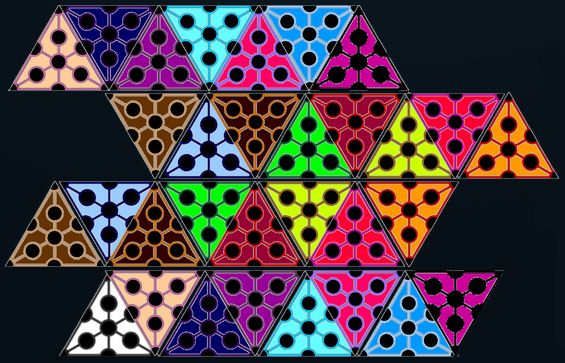
Historic Trigame tile artwork

From paper terrain to digital strategy

Earlier versions focused on colored terrain tiles and physical placement. As the game moved into the browser, coding “accidents” sometimes revealed better rules than the originals. Tile overlap became a feature. Logging became infrastructure. The AI stopped being a difficulty setting and became a cast of personalities.

The current design keeps the spirit of the old board experiments while leaning into the strengths of a digital game: score tracking, AI ladders, move notation, automatic path effects, training matches, and archives of the project's long development trail.

Play NOW

Continue as Guest

Enter a name if you like, or leave it blank and let the page assign one. Then head either straight into solo play or into the Green Room to play with others.

If left blank, the page will assign the next available Guest-n label automatically. Guests now also receive a hidden guest session ID so visible guest numbers can be reused later without confusing identity. Avatar images are optional and tied to that hidden guest session rather than the visible guest label.

Enter The Green Room

Trigame's Green Room is where folks go to join in games with others playing online.

Memebers have special privileges such as choosing who are in included the games they start.

Sign Up

Create a simple member account. Email is optional, though adding one makes it easier to recover your account later.

Avatar images are optional. If you skip email and later lose your sign-in details, the simplest path is to create a new account.

Log In

Return with your user name or email and your password.

Need help signing in?

If you added an email address when you signed up, you can log in with that email instead of your user name.

If you do not remember your password, or if you never added an email address, the simplest path for now is to sign up again.

Meet the fluffle

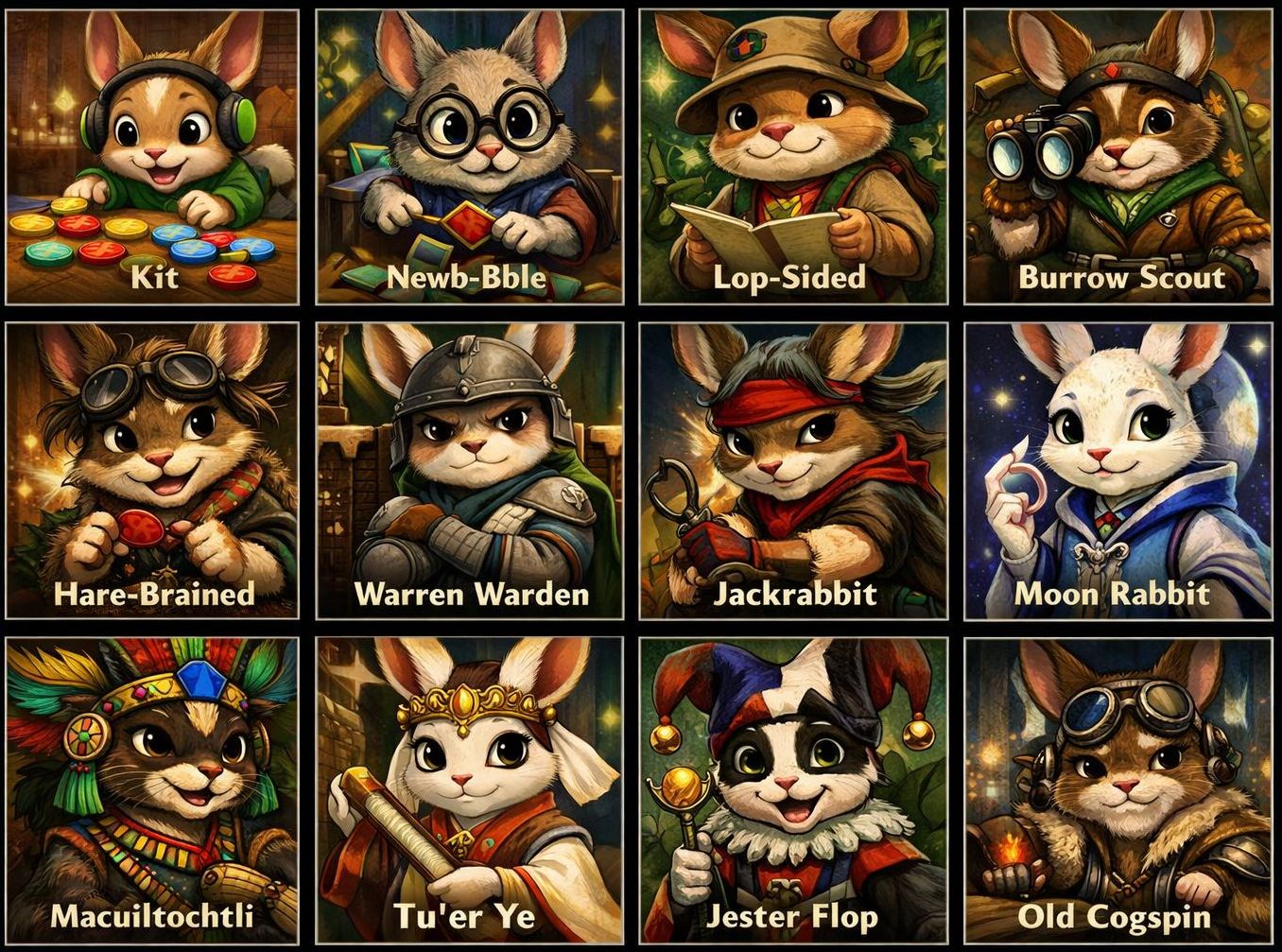
Rusty Rabbit's fluffle

The built-in opponents are not merely “easy” through “hard.” Each of Rusty Rabbit's kin can favor a different habit: Kit loves tiny fireworks, Newb-Bble likes more tiles, Lop-Sided scrambles for one neighborhood, Burrow Scout notices lanes, and stronger rabbits will push deeper into denial, conversion, and endgame control.

The long-term goal is not just stronger AI, but more memorable AI.

To this end, these personalities are handled by individual JavaScript files. We are considering the option of allowing players to create their own AI game characters, so we have included what we are doing now in case anyone wants to see in advance.

Fluffle character personalities JavaScript info..

Development archive

Trigame has a long visible history of versions, from SVG and early Canvas boards to scoring, sound, Game Record notation, Rusty Rabbit, and the current UI. That archive is part of the project's charm and may eventually grow into a structured lesson series.

Read more on the about page →
Rusty Rabbit

Rusty Rabbit is the name ChatGPT chose from working on another related project in which he will be creating a series of lessons on a variety of subjects including writing code. The process of developing this game step by step will serve as examples for his classes. ...Stay tuned!

Part of this ongoing educational aspect of Rusty's is this problem we call the Kit problem. Looking for the best possible moves for a single tile game. See more here: The Kit problem for graduate level math heads.


Comparative Complexity of Trigame

Trigame combines two distinct layers of complexity: a finite local problem and an expanding global problem. A single tile may be treated as a closed combinatorial puzzle with fixed internal structure, while the game as a whole behaves like an open recursive network in which each placement can create additional future placements.

In the discussion that informed this summary, the internal logic of a single tile was described as having approximately 39,916,800 possible permutations. That figure refers only to the bounded logic of one tile or one local sub-problem. The wider game becomes far more complex because each tile placement opens additional sockets, allowing the board to continue expanding outward rather than remaining confined to a fixed grid.

Finite Tile, Divergent Game

Layer Type Description
Single Tile Closed / Finite A bounded combinatorial puzzle governed by fixed internal elements and a finite state space.
Whole Game Recursive / Expanding A growing network of placements in which each move can reshape the future board and enlarge the move tree.

In the same discussion, the game was described as gaining a net of 6 new sockets per tile placement when one socket is consumed and seven new ones are opened. Under that model, the number of available future placements grows rather than shrinks, making the overall game tree increasingly wide and deep as play continues.

Comparison with Checkers, Chess, and Go

Game Board Bounds Termination Complexity Character
Checkers Fixed 8×8 board (32 dark squares in play) Yes Large but finite; smaller than Chess or Go in standard estimates, with roughly 5 × 10²⁰ reachable positions in classic solving analyses, and solved as a draw under perfect play.
Chess Fixed 8×8 board Yes Extremely large but finite game tree; often represented by the Shannon estimate of about 10120.
Go Fixed 19×19 board Yes Vast positional and game-tree complexity, often estimated around 10360 for 19×19 Go.
Trigame Expanding field Not fixed by board size alone Locally finite but globally divergent: complexity grows through recursive placement and expansion.

Illustrative Scale Estimates

The discussion also proposed rough comparison points suggesting that:

  • after about 14 turns, the branching complexity of a Trigame session could exceed the classical Chess estimate;
  • after about 38 turns, it could exceed the classical Go estimate;
  • by about 40 turns, the number of possible continuations would already be astronomically large.

These figures should be read as illustrative comparisons, not as formal proofs, but they communicate an important point: Trigame does not merely have a large number of possible positions; it also has a growth mechanism that can continue enlarging the space of possible play.

Why This Matters for AI

In bounded games such as Chess, strong engines can rely heavily on deep search because the board is fixed. In Go, Monte Carlo Tree Search and neural evaluation work well because, although the state space is vast, the board is still finite. Trigame places a different burden on intelligence: the challenge is not only to calculate well, but to manage the growth of the board itself.

For that reason, Trigame naturally favors:

  • heuristic pruning,
  • pattern recognition,
  • socket prioritization,
  • growth control,
  • and interference with an opponent's future options.

Plain Summary

Chess and Go are deep games played inside fences. Trigame is a deep game in which the field itself can continue to grow. That makes it locally finite, but globally explosive.