Tetgame
Site overview and game history
About Trigame
A guided overview of the site, the game, and the long road from hand-drawn tiles to modern online play, with the original layered triangle displays preserved below.
Hello, guest. You are browsing as a guest.
The game's history: From the 1980's hand drawn to these computer images in 2002.
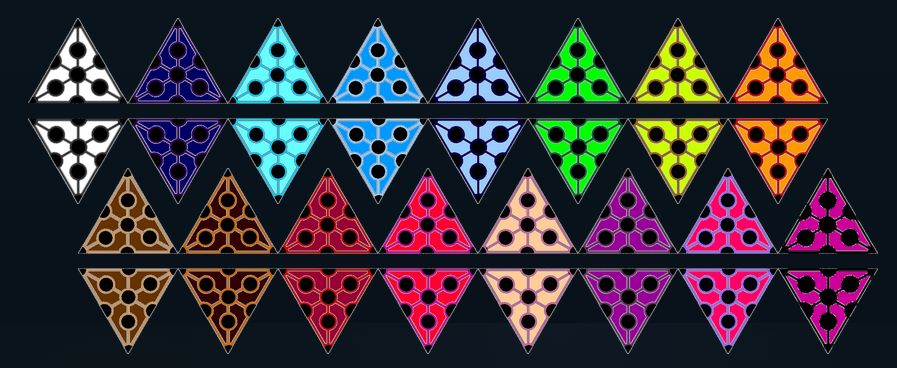
222 (16) different colored tiles, representing different types of terrain.
And then doubled in number by creating a mirrored set oriented in the opposite direction.
Players would begin the game by selecting (drawing?) the tiles and placing them
One per player per turn, until all the tiles had been placed on the board (table.)
Rule #1.) They must be placed edge to edge with others on the board.
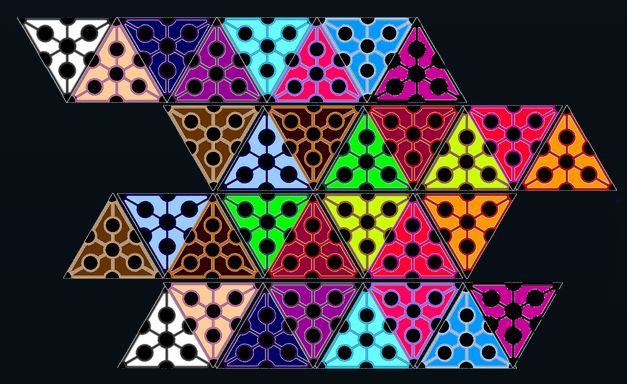
As you can see, these would connect up in a variety of ways.
The circles on the tiles represent places where players could place tokens. And that would be the next part of the game:
Each player in turn placing their tokens or markers on the board, claiming these places.
 Twenty three years later...
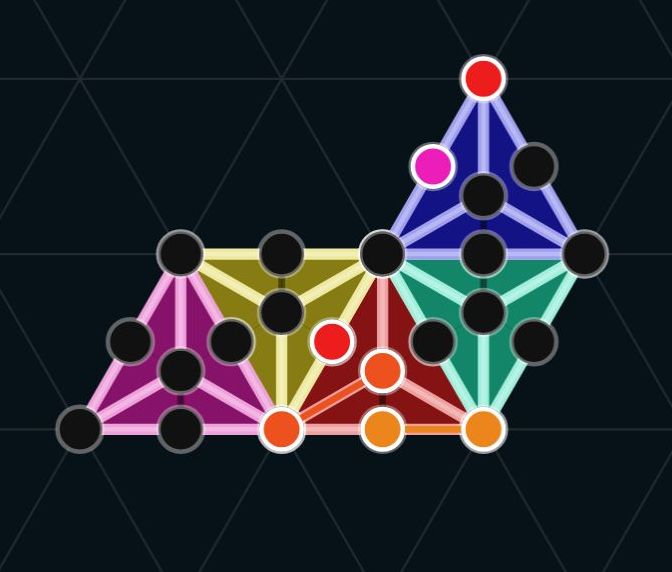
As the game has progressed to becoming a computer game, it's very nature has been altered.
Much of this is strangely due to accidents in coding, then deciding that the outcome was most desireable. I have considerable help from Chat GPT, and have had to take a baby steps aproach while simultaneously keeping the big picture in mind.
The game has gone from being about real terrain with a combative concept to one that is now more abstract and almost competivly constructive in its nature.
It is now a stategy game, a bit like GO in it's nature yet, different. Settled on having 12 players at the maximum due to needing to distinguish player colors. And unlike many other games, no one is elimated during play. ...I like this, as it always seemed harsh that some would have to sit out waiting for the others to finish a game.
Time will tell if this becomes fun and challenging for folks or not.
Here are three of the very earliest versions in the development process:
Test 2 - SVG version
Test 4 - Canvas version
Test 9 - Canvas version, corrected geometry and placement.
The end of this first stage created a fully functional game. Its rules and features continued on to the next stages fully intact. It runs on a single machine, (computer or cell phone browser) in serveral modes of play.
- (Players) Practice
In this mode the player acts as all 12 contestants.
- (players) 2-12
In this mode the player acts as all 12 contestants.
- Demo
In this mode, 2-12 rabbots may be selected to play against each other.
- Play
In this mode the player may act as any of the 12 contestants or choose a rabbot for any of them.
In this mode the player acts as all 12 contestants.
In this mode the player acts as all 12 contestants.
- Demo
In this mode, 2-12 rabbots may be selected to play against each other. - Play
In this mode the player may act as any of the 12 contestants or choose a rabbot for any of them.
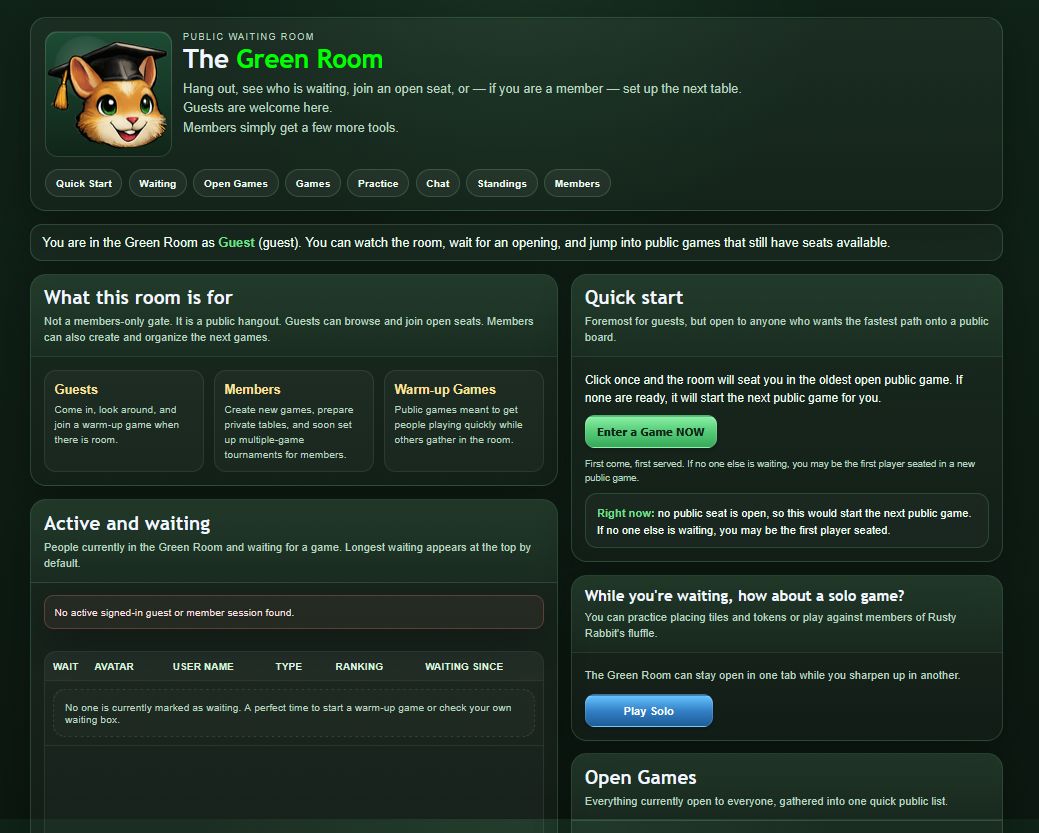
Stage two: The Green Room
Initially developed as a webpage, players would have to pass the mouse around the room for others to play, or play against the built in AI bots.
The next stage of development allowed folks on different computers to play together over the internet. This led to the inclusion of a waiting room called the Green Room and many additional features such as creating instances of games and selecting other players to join them.
Membership became an option and like the arcade games of the past, top members were listed and ranked.
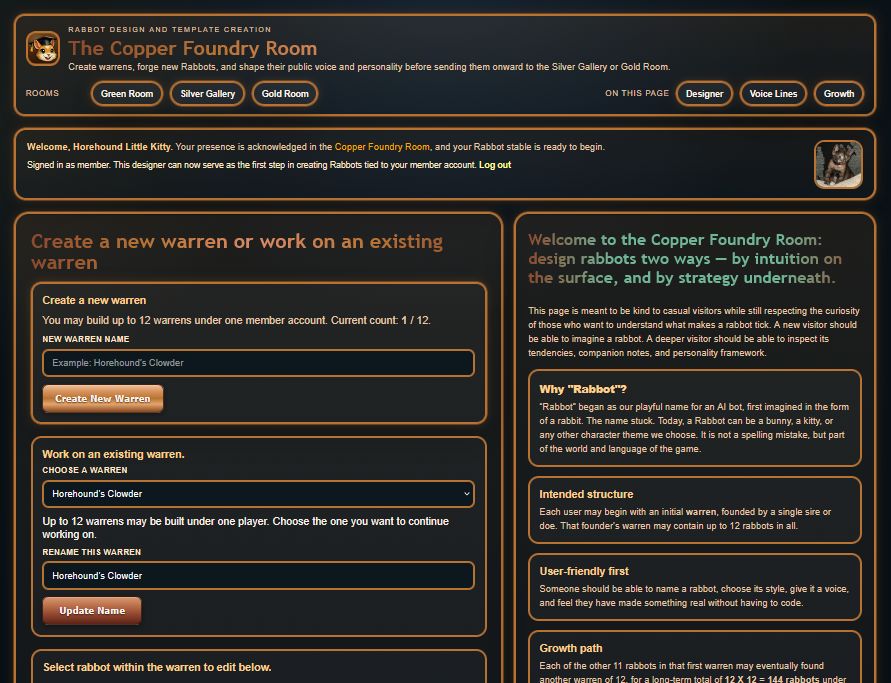
Stage three: The Copper Foundry
Members can now create thier own AI bots, we call Rabbots.
Such Rabbots, are able to participae in games or teams of them pitted against each other.
Enter the Copper Foundry to do so from the Green Room. The Copper Foundry is where a Rabbot first takes shape. Here, members can design identity, appearance, voice, and the early details that give each character its own spark.
It is the workshop stage: part sketchbook, part forge, and the first step in bringing a new Rabbot into the world.
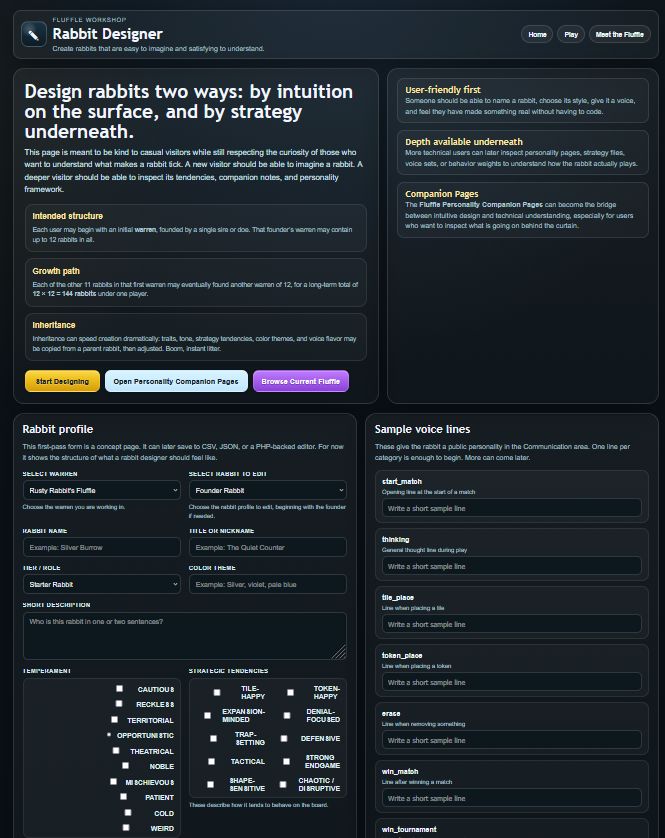
Stage four: The Silver Gallery
The Silver Gallery is where Rabbots are gathered, arranged, and presented in a more polished public setting. It serves as the space between raw creation and deeper technical work: a place to review warrens, browse individual Rabbots, shape how they are introduced, and refine the text, tone, and visual presentation that others will encounter first.
Here, members can work on the public-facing side of a Rabbot's identity, deciding how it should be described, displayed, and understood within the wider world of Trigame.
It is, in a sense, the exhibition hall of the Rabbot rooms. The Copper Foundry is where a Rabbot is first formed, and the Gold Room is where its deeper workings may be studied, but the Silver Gallery is where character, presentation, and atmosphere are brought into focus. It is the place for inspection, curation, and polish - where a Rabbot begins to feel less like a draft and more like a distinct presence within its warren.
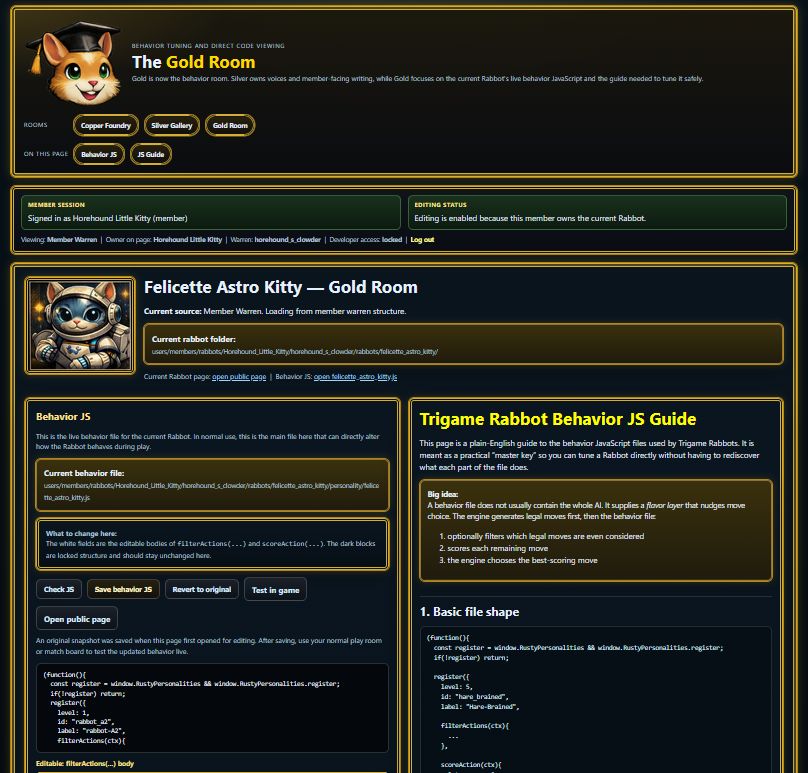
Stage five: The Gold Room
The Gold Room is where a Rabbot's deeper nature may be examined, tested, and refined. It is the advanced chamber of the three: a place for looking beyond outward presentation and into the logic, behavior, and working structure that guide how a Rabbot thinks and acts. Here, members may study the files and rules that shape a Rabbot's conduct, make careful adjustments, and explore how those changes affect its behavior in actual play. It is a room for precision, experimentation, and thoughtful development rather than simple display.
While the Copper Foundry is concerned with first creation, and the Silver Gallery with presentation and polish, the Gold Room is concerned with function. This is where a Rabbot may be tested in a more serious way, where ideas can be revised, where behavior can be compared against intention, and where members can move from appearance into craftsmanship of a deeper sort. It is both workshop and laboratory: a place for focused improvement, careful testing, and the gradual shaping of a Rabbot into something more capable, more distinct, and more alive within the game.
Stage six: Spectators:
Back in the Green Room...
Would a game be complete if others couldn't watch? This next stage was creating a version of the game for those who just want to watch as other played. Buttons were added to the Green Room to the games for spectators to watch them. Everything looks the same except that spectators can't actually make movers or start matches, but they can still adjust the view of the board, sizing and shifting it.
Added to the spectator version were three buttons to create sounds for cheers etc. in the chat area. Chat remained functional as well for spectators.