Comparative Complexity of Trigame
Trigame combines two distinct layers of complexity:
a finite local problem and an expanding global problem.
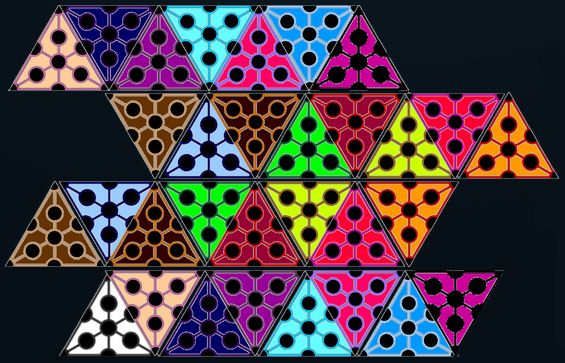
A single tile may be treated as a closed combinatorial puzzle with fixed internal structure,
while the game as a whole behaves like an open recursive network in which each placement can create
additional future placements.
In the discussion that informed this summary, the internal logic of a single tile was described as having
approximately 39,916,800 possible permutations.
That figure refers only to the bounded logic of one tile or one local sub-problem.
The wider game becomes far more complex because each tile placement opens additional sockets,
allowing the board to continue expanding outward rather than remaining confined to a fixed grid.
Finite Tile, Divergent Game
| Layer |
Type |
Description |
| Single Tile |
Closed / Finite |
A bounded combinatorial puzzle governed by fixed internal elements and a finite state space.
|
| Whole Game |
Recursive / Expanding |
A growing network of placements in which each move can reshape the future board and enlarge the move tree.
|
In the same discussion, the game was described as gaining a net of 6 new sockets per tile placement
when one socket is consumed and seven new ones are opened.
Under that model, the number of available future placements grows rather than shrinks,
making the overall game tree increasingly wide and deep as play continues.
Comparison with Chess and Go
| Game |
Board Bounds |
Termination |
Complexity Character |
| Chess |
Fixed 8×8 board |
Yes |
Extremely large but finite game tree; often represented by the Shannon estimate of about
10120.
|
| Go |
Fixed 19×19 board |
Yes |
Vast positional and game-tree complexity, often estimated around
10360 for 19×19 Go.
|
| Trigame |
Expanding field |
Not fixed by board size alone |
Locally finite but globally divergent: complexity grows through recursive placement and expansion.
|
Illustrative Scale Estimates
The discussion also proposed rough comparison points suggesting that:
- after about 14 turns, the branching complexity of a Trigame session could exceed the classical Chess estimate;
- after about 38 turns, it could exceed the classical Go estimate;
- by about 40 turns, the number of possible continuations would already be astronomically large.
These figures should be read as illustrative comparisons, not as formal proofs,
but they communicate an important point:
Trigame does not merely have a large number of possible positions;
it also has a growth mechanism that can continue enlarging the space of possible play.
Why This Matters for AI
In bounded games such as Chess, strong engines can rely heavily on deep search because the board is fixed.
In Go, Monte Carlo Tree Search and neural evaluation work well because, although the state space is vast,
the board is still finite.
Trigame places a different burden on intelligence:
the challenge is not only to calculate well, but to manage the growth of the board itself.
For that reason, Trigame naturally favors:
- heuristic pruning,
- pattern recognition,
- socket prioritization,
- growth control,
- and interference with an opponent's future options.
Plain Summary
Chess and Go are deep games played inside fences.
Trigame is a deep game in which the field itself can continue to grow.
That makes it locally finite, but globally explosive.
 -PLAY
Single-Tile Problem
Sound editor
JS
Legacy prototype (2002)- modern Canvas versions (2026)
-PLAY
Single-Tile Problem
Sound editor
JS
Legacy prototype (2002)- modern Canvas versions (2026)