
Help and Instructions for: TRIGAME
⬤
⬤
⬤
⬤
⬤
⬤
The Board.
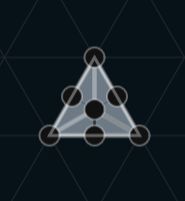
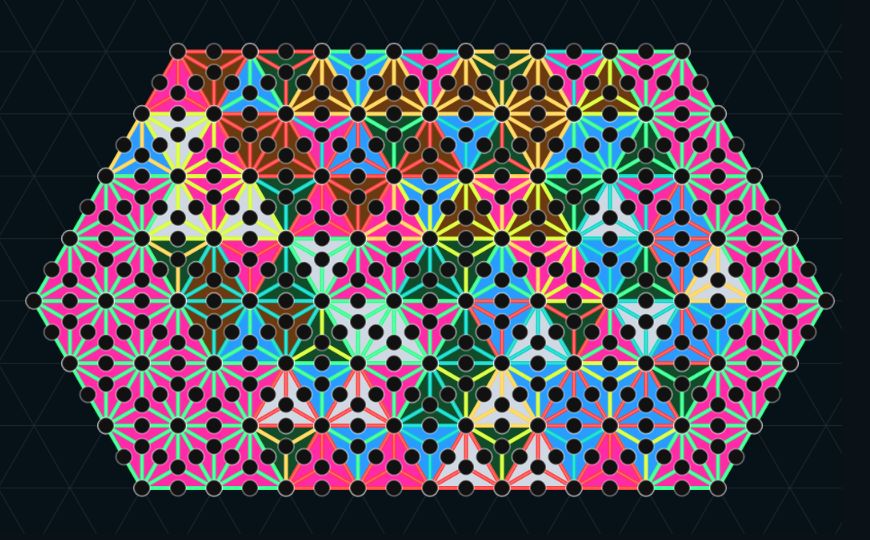
The board, or playing field, is dark, with light guide lines showing the triangular position of the tile to be placed there.
Center gray tile.
At the center of the board is a ghosted gray tile. This marks the starting position of the game, and the first tile must be placed on it.
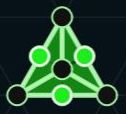
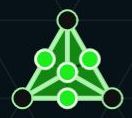
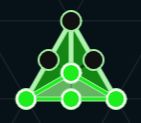
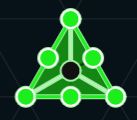
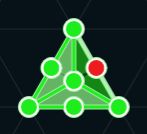
Shown below on the left is a typical tile.
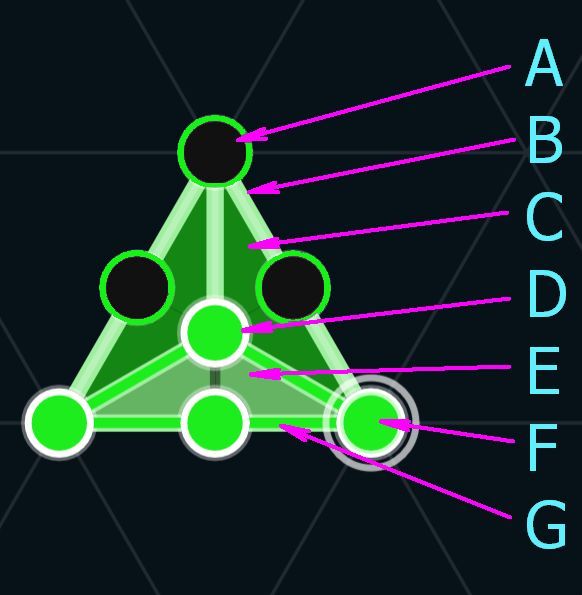
Tiles include the following features:
- Socket, unclaimed
- Path, unclaimed
- Partial territory, unclaimed
- Socket claimed by a token
- Partial territory, claimed
- Socket circled to show correct token placement
- Path, claimed
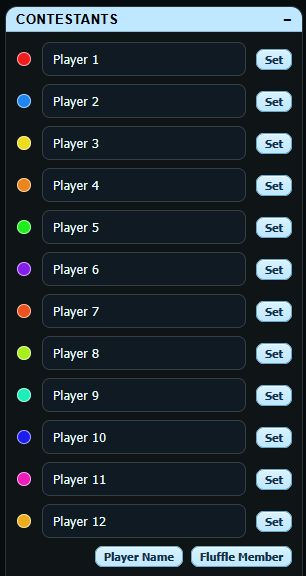
CONTESTANTS & Players
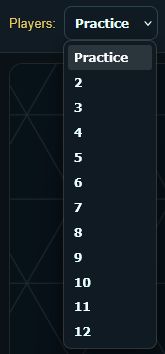
At the start of the game, the number of players should be selected from the top control bar.
Up to 12 players may play at one time, and are shown in the player section.
Each is asigned a default name and color in order.
Names of human players can be changed at any time.
Players too can be changed at any time.
Trigame is designed with the flexability to allow both human and AI players.

Rusty Rabbit is our AI co-developer and has provided his fluffle of relatives as AI players.
Meet Rusty's fluffle of relatives:
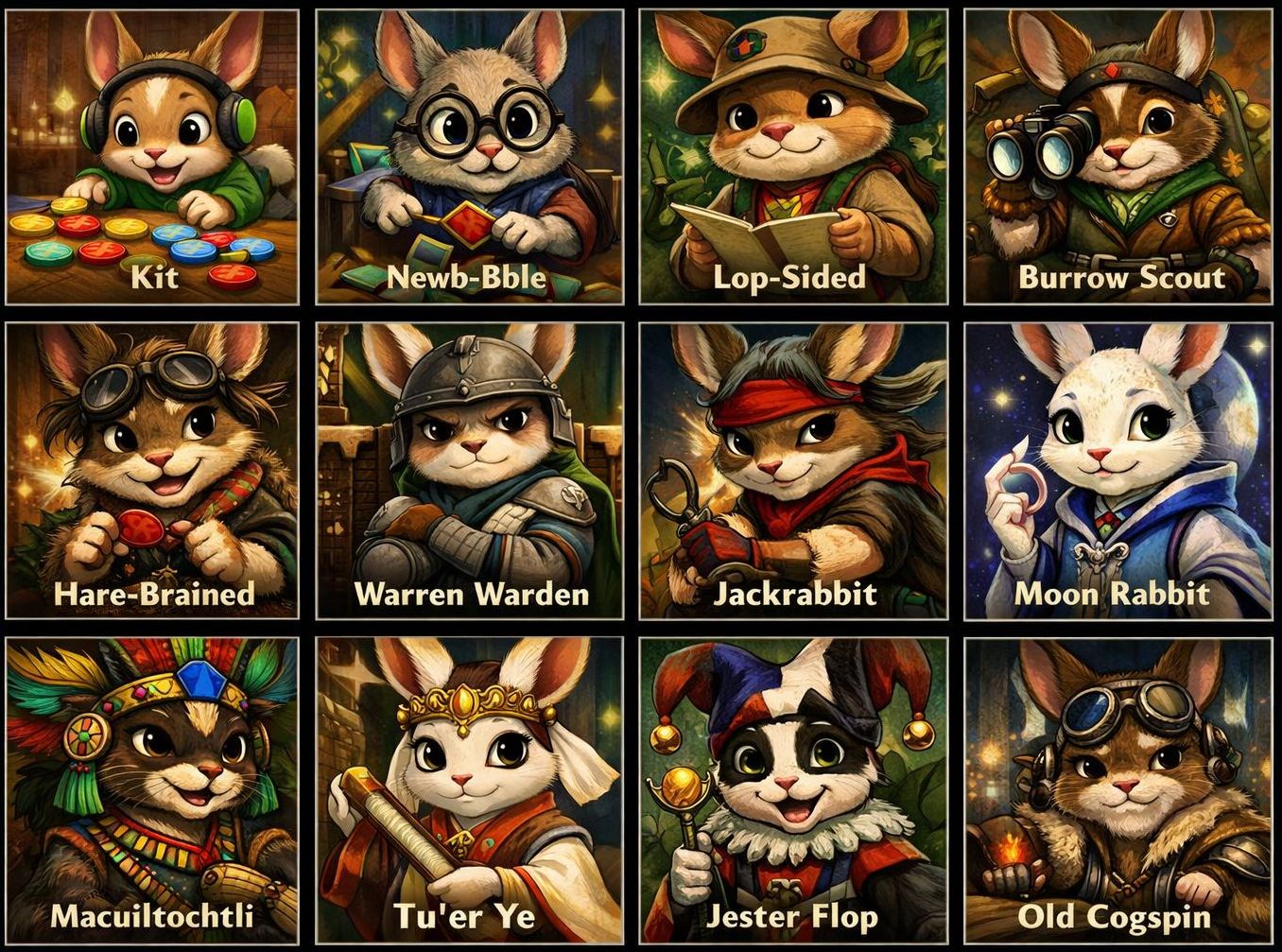 Kit
Kit
Our baby bunny who makes almost random moves, and just loves those colorful dots!
Newb-Bble
Who is older and notices immediate sub-tile gains... sometimes.
Lop-Sided
Who prefers local clusters, but has a weak shape sense.
Burrow Scout
Who seems to notice expansion lanes better.
Hare-Brained
Who is opportunistic, tactical, but a bit inconsistent.
Warren Warden
Who starts defending and denying well compared to the previous rabbits here.
Jackrabbit
Who is a fast tactical hunter and senses strong immediate sequences.
Moon Rabbit
Who is more positional and values shape and branching.
Macuiltochtli
Who is dangerous, weird, disruptive, with a strong denial play style.
Tu’er Ye
Who is cold, maximizing, deep-searching, and plays a ruthless endgame.
Jester-Flop
Who cheats, capers, and laughs it off when caught. (Currently banned from playing.)
Old Cogspin
Who modifies the machinery, reinterprets the rules, and wins by technicality. (Also currently banned from playing.)
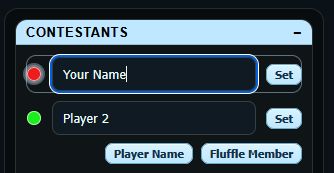
Changing names and players:
Players may enter their name to replace the default of just a player number.
- Click the colored dot or field to change.
- Click the player name button
 at the bottm of the list.
- Type in the new name.
- Click the set
 button .
|
|
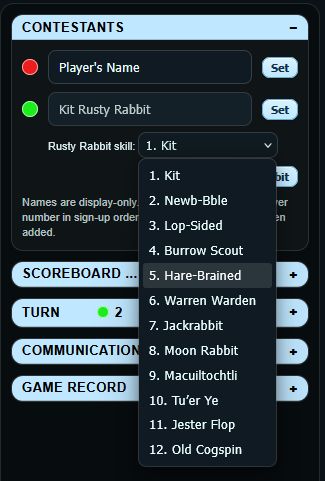
To add a member of the fluffle:
- Click the desired player field for the new player.
- Click the Fluffle Member
 button. button.
- Select member from the dropdown list.
- Click the set button .
Warning: Rusty Rabbit has banned both Jester-Flop and Old Cogspin from their regular family tournaments for cheating. You would be wise to do the same. Jester-Flop is a magician and a joker, while Old Cogspin is a ruthless and highly intellegent hacker.
|
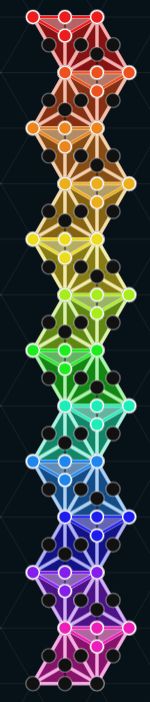
Player colors for 12 players.
Players are assigned colors in the order of entering the game to play. Tiles are initially two colors based on the players set of colors below. Colors changet to indicate who has place a token on the socket, or claimed a path between tokens or captured a partial tile or whole tile by having tokens all around it and in the center in the case of a full tile.
Player #
|
Token
Owned Path |
Unowned
Path |
Unowned
Territory |
Owned
Territory |
| 1. Red |
|
|
|
|
| 2. Blue |
|
|
|
|
| 3. Yellow |
|
|
|
|
| 4. Orange |
|
|
|
|
| 5. Green |
|
|
|
|
| 6. Violet |
|
|
|
|
| 7. Red-Orange |
|
|
|
|
| 8. Yellow-Green |
|
|
|
|
| 9. Blue-Green |
|
|
|
|
| 10. Blue-Violet |
|
|
|
|
| 11. Red-Violet |
|
|
|
|
| 12. Yellow-Orange |
|
|
|
|
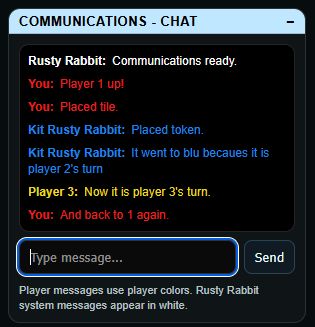
COMMUNICATIONS - CHAT.
The Communications - Chat panel provides a place for player messages and game notices.
Messages entered here appear in the black message window above the entry box.
For now, a typed message is shown in the color of the current player. This helps match the message to the player whose turn it is.
Messages from Rusty Rabbit, such as system notices or helper comments, appear in white.
The text field at the bottom is used to enter a message. Press Send, or press Enter, to post it.
At present, this panel is mainly a local feature for testing and for preparing future multi-player versions of the game.
In later online versions, this same area may be used for live player chat, turn announcements, invitations, and other game-related communication.
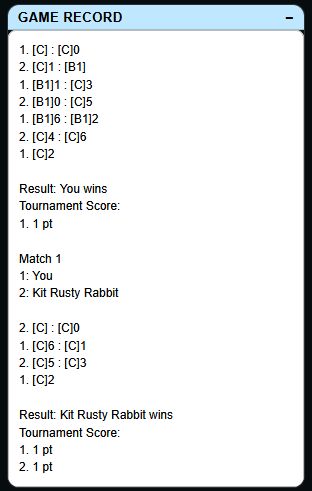 GAME RECORD
Not needed in the slightest to play the game, the develpment process was aided by the creation of a system of recording and tracking events. This has helped in fine tuning the personalities of the fluffle. It was interesting enough as a feature to have been left in. At games end it can be copied to your computer's clipbard and pasted to a text file for reference or sharing or just to document your games.
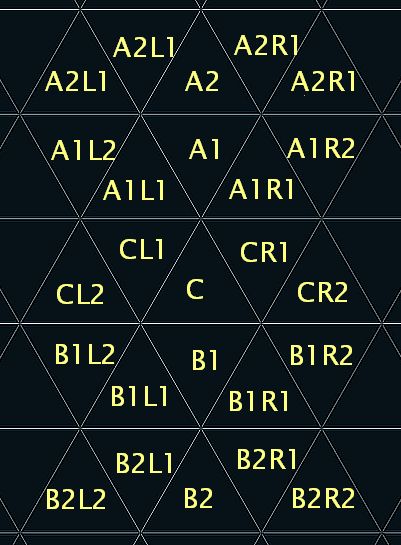
Trigame can be described in a compact symbolic form so a full game may be copied,
saved, or shared as plain text.
-
Tile location:
A tile is written inside square brackets.
Example: [C] means the center tile.
[A1] means the tile one row above center.
[B1] means the tile one row below center.
[CL1] means the tile one position left of center.
[CR1] means the tile one position right of center.
-
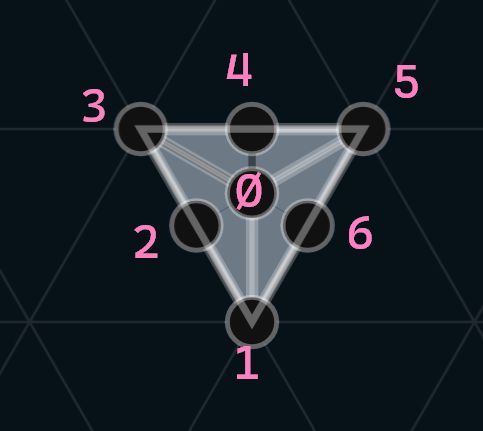
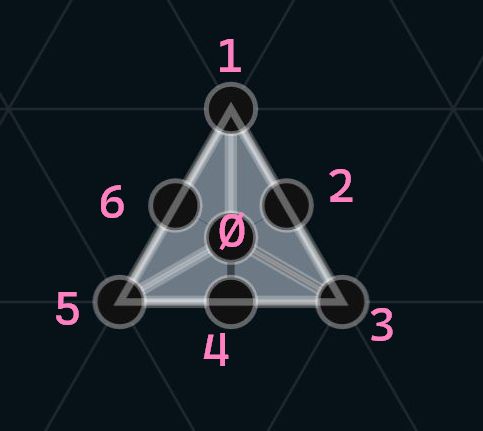
Socket number:
Add a number after the tile reference to indicate a socket on that tile.
0 is the center socket.
1 through 6 count clockwise around the tile.
Example: [C]3
-
Tile placement:
A tile placement is written as the tile reference only.
Example: [A1]
-
Token placement:
A token placement is written as the tile reference followed by the socket number.
Example: [C]0 or [A1]5
-
Erasing:
A minus sign before the move means that token is erased.
Example: -[C]0
-
Multiple actions:
Actions within one turn are separated by a colon.
Example: [A1] : [A1]0
-
Per-player record:
Each move line begins with the player number.
Example: 1. [C] : [C]0
A further note on tokens:
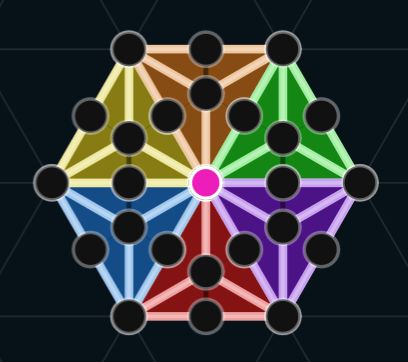
It simply does not matter which tile is used in referencing a token.
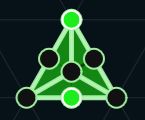
Note the picture to the right:
The red token in the center is common to six different tiles.
Any may be used as a reference for it, and all may be said to be pointing either up or down.
Starting with the point as 1, count clockwise until you get to the red token, and that is its number when referenced by that tile.
For the green tile it would be 5, but for the purple tile it would be 3 and it would be 4 again if referring to the blue tile.
Examples
1. [C] : [C]0
2. [C]5 : [C]4
4. -[C]0 : [C]0
This notation makes it possible to copy and save a game record as text, then later
replay or analyze the moves.
Order of Play and Procedures:
A player's turn normally allows two actions .
Bonus actions may also be awarded.
Possible actions include the following:
- Place a tile on the board.
A tile may not be placed against an edge with a token on it.
- Place a token on the board.
They are placed only on empty sockets.
- Remove a tile from the board.
A tile may not be removed if it has a token on it.
- Remove a token from the board.
Tokens must be isolated and not connected by an occupied path.
- Skip the turn to the next player.
(Only allowed once per game or match.)
First turn of the game (first player only):
First action of the first turn of the game: A player must do one of the following:
- Place a tile on the board.
- Skip the turn to the next player.
Second action of the first turn of the game: A player may do one of the following:
- Place a tile on the board.
- Place a token on the board.
- Skip the turn to the next player.
Normal play:
First action of each player's turn: A player may do any of the following:
- Place a tile on the board.
- Place a token on the board.
- Remove a tile from the board.
- Remove a token from the board.
- Skip the turn to the next player.
Second action of each player's turn: A player may do any of the following:
- Place a tile on the board.
- Place a token on the board.
- Skip the turn to the next player.
Bonus action:
A bonus action results from capturing a tile.
...Having tokens on every socket of the tile:
- Place a token on the board.
- Skip the turn to the next player.
Locked board:
- The board is said to be locked when no more tiles can be placed.
- Tiles and tokens may not be removed when the board is locked.
Additional notes:
- After the first tile has been placed, all new tiles must be placed edge to edge with an existing tile.
- Trigame automatically assumes tournament play, consisting of multiple matches or games.
- End Tourny ends a series of matches or games, ending the tournament.
Game Vocabulary.
Players — primary term for the player-count control and player area.
Play — primary term for normal interactive mode.
Demo — primary term for automatic demonstration mode.
Tile — primary term for the board piece placed on the board.
Token — primary term for the marker placed on the board.
Place — primary verb for adding a tile or token.
Remove — current primary button label for taking a tile or token off the board.
Turn — primary term for one player’s turn.
Action — primary term for one of the actions within a turn.
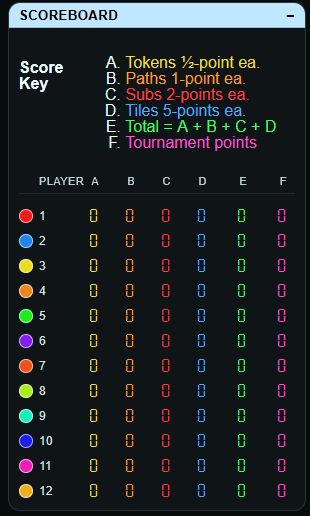
Scoring — primary term for the scoring panel/section.
Match — primary term for one completed game in the running sequence.
Tournament Score — primary term for the running score across matches.
Game Record — current primary term for the running textual log/record of play.
Board locked — primary term for the locked-board state.
Game over — primary term for the end-of-game state.
Socket — primary term for a token location or target point.
Gray start triangle — primary term for the required first-tile starting location.
Edge-to-edge — primary term for valid tile contact.
Overlaps — primary term for tile overlap behavior.
Path — currently used in project wording for path behavior and token propagation.
Subs — currently used in project wording for the smaller scored sub-areas.
Full tile — primary scoring/event term for a completed tile state.
New Game — primary button label for starting fresh.
End Tourny — current primary button label for ending the tournament.
Copy Game — primary button label for copying the game record.
Reset — primary button label for resetting the view.
 -PLAY
Sound editor
Legacy prototype (2002) - modern Canvas versions (2026)
-PLAY
Sound editor
Legacy prototype (2002) - modern Canvas versions (2026)
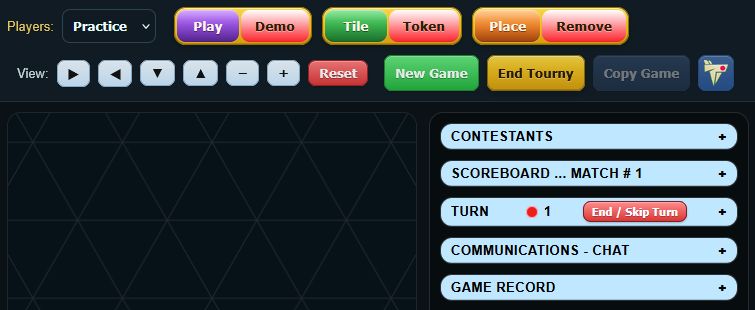











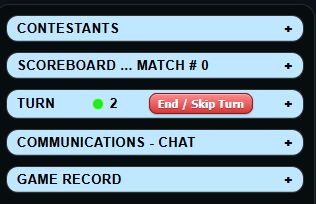






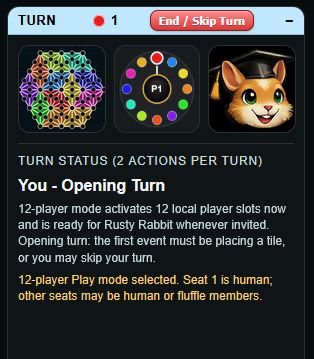
 button may be used to end the current player’s turn before both actions are used.



 ←
←