 Trigame
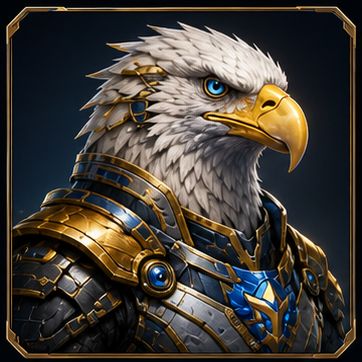
Aquila Talon
She reads the field like a cliff-face thermal. Aquila prefers clean high-ground plans, patient pressure, and captures that seem obvious only after she has already closed the sky.
Sky commander
Expanding 3D strategy
A game of tetrahedrons, tokens, paths, captured volumes, and Rabbot minds learning to forecast a board that grows as it is played.
Tetgame is a three-dimensional strategy game built from tetrahedrons. Players place tets, claim sockets with tokens, capture paths between tokens, and work upward toward sub-tetrahedron and whole-tet ownership.
Unlike games played on a fixed board, Tetgame's field is part of the contest. Each new tet can create more places to play, more ways to block, and more future choices to evaluate.
The playable Tetgame page and the original Babylon.js visual sample are kept here together for reference.
The active Tetgame prototype is the working play page: tets, sockets, tokens, paths, scoring, saved boards, and Rabbot-seated matches.

This earlier visual sample remains a useful comparison point for the tetrahedral look, lighting, color, and geometry.
How the expanding board and local capture rules compare with familiar classic games.
Trigame and Tetgame combine two distinct layers of complexity: a finite local problem and an expanding global problem. A single tile or tet may be treated as a closed combinatorial puzzle with fixed internal structure, while the game as a whole behaves like an open recursive network in which each placement can create additional future placements.
In the discussion that informed this summary, the internal logic of a single Trigame tile was described as having approximately 39,916,800 possible permutations. That figure refers only to the bounded logic of one tile or one local sub-problem. The wider game becomes far more complex because each tile placement opens additional sockets, allowing the board to continue expanding outward rather than remaining confined to a fixed grid.
Tetgame follows the same general idea, but moves the logic into a tetrahedral field. A single tet has sockets, paths, sub-territories, and full-tet ownership. This means Tetgame is not only an expanding placement game, but also a layered capture game in which center sockets, corner sockets, automatic path fills, subs, and whole-tet captures can all affect the score.
| Layer | Type | Description |
|---|---|---|
| Single Trigame Tile | Closed / Finite | A bounded combinatorial puzzle governed by fixed internal elements and a finite state space. |
| Single Tetgame Tet | Closed / Finite | A bounded 3D local puzzle with sockets, paths, four sub-territories, and possible full-tet ownership. |
| Whole Trigame | Recursive / Expanding | A growing 2D network of tile placements in which each move can reshape the future board and enlarge the move tree. |
| Whole Tetgame | Recursive / Expanding / Layered | A growing tetrahedral network in which players manage expansion, blocking, token placement, path capture, sub capture, and full-tet capture. |
In Trigame, the game was described as gaining a net of 6 new sockets per tile placement when one socket is consumed and seven new ones are opened. Under that model, the number of available future placements grows rather than shrinks, making the overall game tree increasingly wide and deep as play continues.
In Tetgame, a simple tree-like estimate gives approximately 5T + 6 unique token sockets, where T is the number of tets. A one-tet board has 11 sockets. Each additional face-to-face tet shares part of its structure with the existing board, but still adds new sockets, new paths, and new capture opportunities. A 9-tet position may therefore contain about 51 token sockets, along with many possible path, sub, and full-tet consequences.
| Game | Board Bounds | Termination | Complexity Character |
|---|---|---|---|
| Checkers | Fixed 8×8 board; 32 dark squares in play | Yes | Large but finite; smaller than Chess or Go in standard estimates, with roughly 5 × 10²⁰ reachable positions in classic solving analyses, and solved as a draw under perfect play. |
| Chess | Fixed 8×8 board | Yes | Extremely large but finite game tree; often represented by the Shannon estimate of about 10120. |
| Go | Fixed 19×19 board | Yes | Vast positional and game-tree complexity, often estimated around 10360 for 19×19 Go. |
| Trigame | Expanding 2D field | Not fixed by board size alone | Locally finite but globally divergent: complexity grows through recursive placement and expansion. |
| Tetgame | Expanding tetrahedral field | Not fixed by board size alone | Locally finite, globally expanding, and tactically layered: each move may affect tet growth, blocking, tokens, paths, subs, and full-tet ownership. |
The discussion also proposed rough comparison points suggesting that:
These figures should be read as illustrative comparisons, not as formal proofs, but they communicate an important point: Trigame does not merely have a large number of possible positions; it also has a growth mechanism that can continue enlarging the space of possible play.
Tetgame adds another wrinkle. A single turn may contain two actions, and each action may create consequences: a tet may open new faces, a token may capture paths, two corner tokens may auto-fill an edge socket, a center socket may unlock sub-capture possibilities, and a set of subs may lead to a full-tet capture. This makes the practical branching of a Tetgame turn larger than it first appears.
In bounded games such as Chess, strong engines can rely heavily on deep search because the board is fixed. In Go, Monte Carlo Tree Search and neural evaluation work well because, although the state space is vast, the board is still finite. Trigame and Tetgame place a different burden on intelligence: the challenge is not only to calculate well, but to manage the growth of the board itself.
Chess and Go are deep games played inside fences. Trigame is a deep game in which the field itself can continue to grow. Tetgame carries that idea into a tetrahedral field, where growth, blocking, paths, subs, and full-tet ownership all interact.
Trigame is locally finite, but globally explosive. Tetgame is locally finite, globally explosive, and tactically layered.
In Checkers, Chess, and Go, the board is fixed. The game tree may be enormous, but the container is known. Tetgame changes the problem: every expansion can create new future options, so the strategic burden is not only finding a good move, but shaping the future board itself.
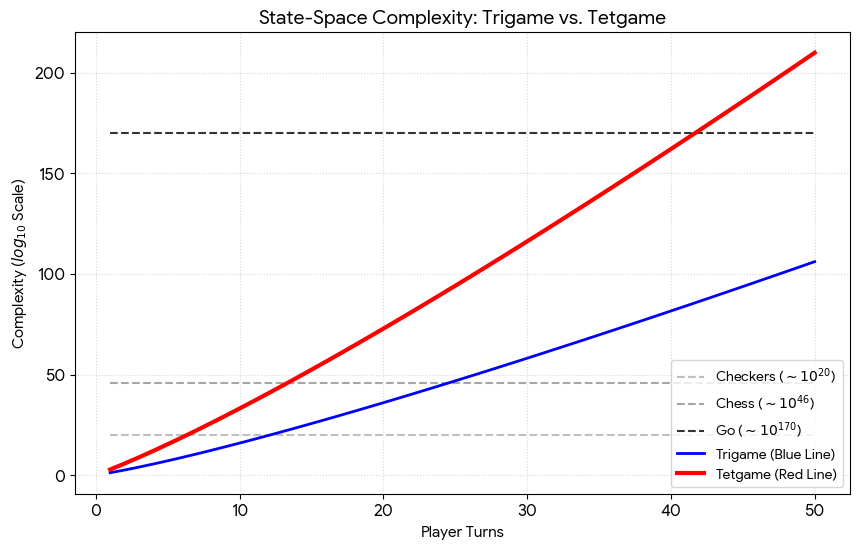
A comparison of state-space complexity and branching factors between classic finite board games and the expanding recursive systems of Trigame and Tetgame.
| Game | Board bounds | Growth character | Useful comparison | Avg. Branching Factor (b) | State-Space Complexity |
|---|---|---|---|---|---|
| Checkers | Fixed 8×8 board | Shrinking | Large but bounded; pieces leave the board over time. | ~3 | ~1020 |
| Chess | Fixed 8×8 board | Finite | Vast search tree, but all play remains inside the same square field. | ~1046 | Fixed (8x8) - Shrinking |
| Go | Fixed 19×19 board | Filling | Huge positional space, but legal placements generally decrease as the board fills. | ~10170 | Fixed (19x19) - Filling |
| Trigame | Expanding 2D field | Recursive | Locally finite, globally explosive through tile and socket expansion. | Infinite | Expanding (Recursive 2D) |
| Tetgame | Expanding 3D field | Dual-action 3D | Combines recursive expansion with volumetric scoring layers. | Infinite | Expanding (Dual-Action 3D) |
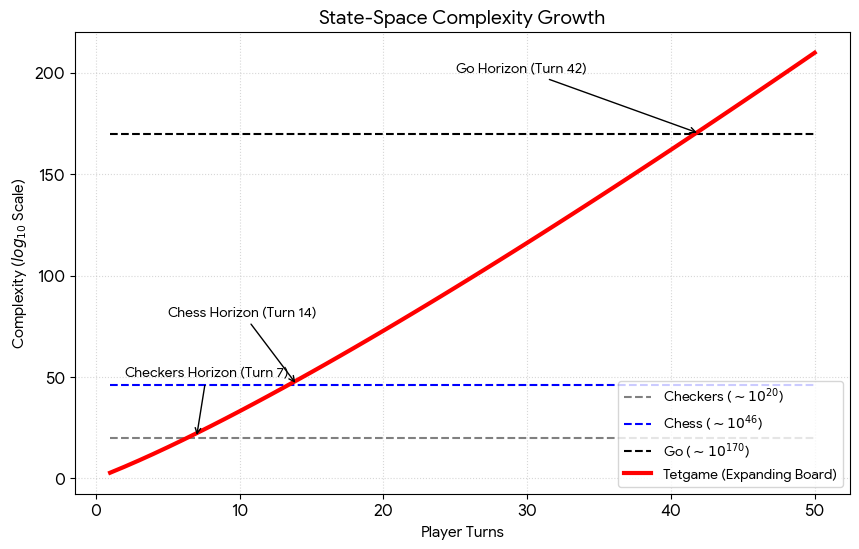
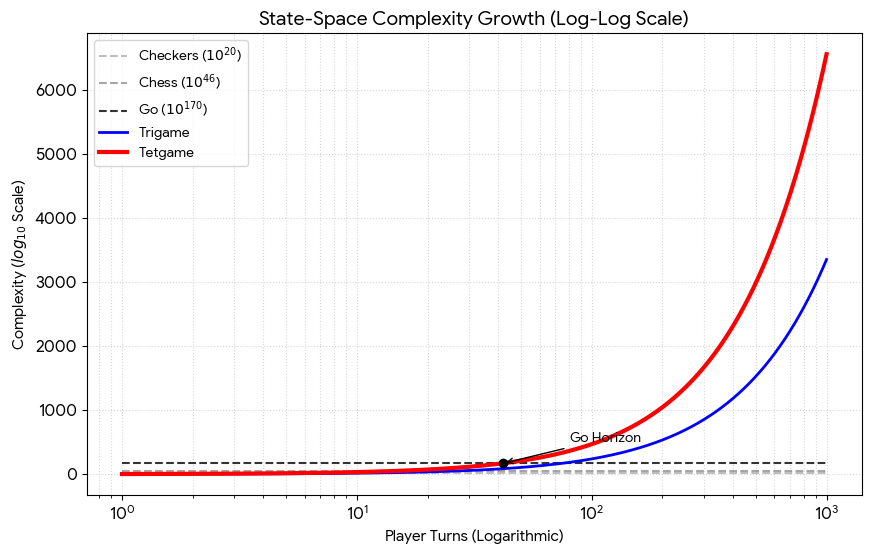
A useful way to describe Tetgame's scale is the Go Horizon: the point where an illustrative Tetgame move tree becomes comparable to, or larger than, the estimated state-space of a 19×19 Go board.
This is why Tetgame AI cannot rely on brute force. A Rabbot must use priorities: where to grow, where to block, when to capture, when to deny a center, and when to sacrifice a small path to gain a larger volume.
The state-space complexity of Tetgame ( ) at turn can be modeled by the product of its expanding branching factor across dual-action turns:
Where:
In Go, the branching factor () decreases as the board fills. In Tetgame, the branching factor increases. By Turn 42:
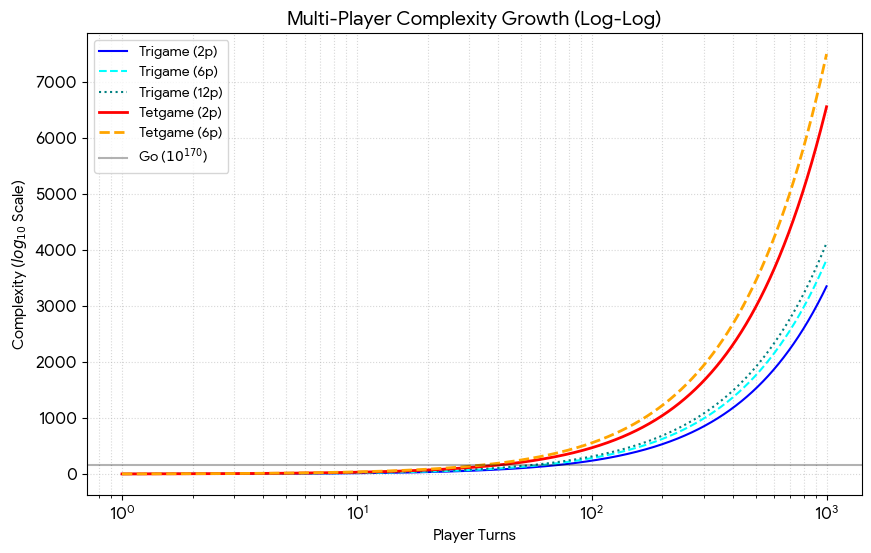
Complexity in these systems is driven by the Rate of Expansion. In a 12-player Trigame, the board grows so rapidly that it surpasses the complexity of Go by turn 38. However, Tetgame remains the most computationally dense; even with only 2 players, its dual-action turn structure allows it to reach the 'Go Horizon' faster than a 6-player Trigame match.
| Configuration | The Go Horizon (Turn) |
|---|---|
| Trigame (2 players) | 102 |
| Trigame (12 players) | 38 |
| Tetgame (2 players) | 42 |
| Tetgame (6 players) | 26 |
Enter the current turn number to see the estimated state-space complexity (C) of the game tree.
Tetgame's computer players are Rabbots. Each Rabbot has a shared identity: name, portrait, temperament, voice, and Warren membership.
The Tet Rabbot Warren is the official twelve-Rabbot Warren for Tetgame. These profiles are active and ready to be seated once the Blue Room game-start wiring is added.

These twelve Rabbots are not just portraits. They are a personality map for future 3D play: each one should eventually feel different at the board, with a recognizable temperament, voice, and style of pressure.
She reads the field like a cliff-face thermal. Aquila prefers clean high-ground plans, patient pressure, and captures that seem obvious only after she has already closed the sky.
Sky commander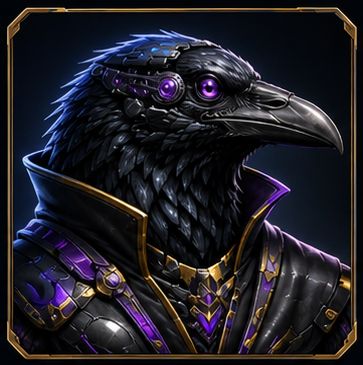
She is a black-winged opportunist with a storyteller's patience. Morrigan watches the loose socket no one respected, then turns it into a clever, cackling chain.
Clever omen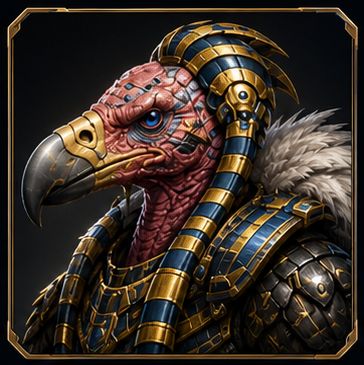
He waits like a desert undertaker. Grim Pharaoh does not rush the harvest; he circles damaged structures and claims the board when the position has dried out.
Desert harvester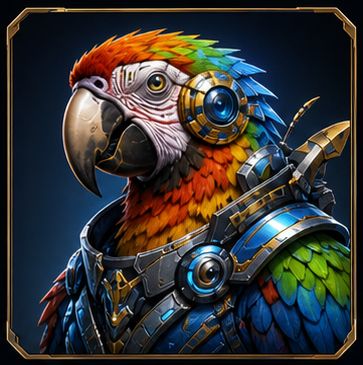
She listens first and answers twice. Echo Echo studies whatever pattern is working, mirrors it back, and then twists the rhythm until the opponent is playing her song.
Chorus mimic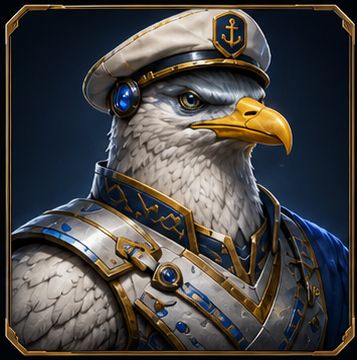
He is all surf, racket, and stolen french fries. Scuttle Bay darts into open space, pesters unfinished work, and escapes with points before anyone admits they left them unattended.
Shoreline thief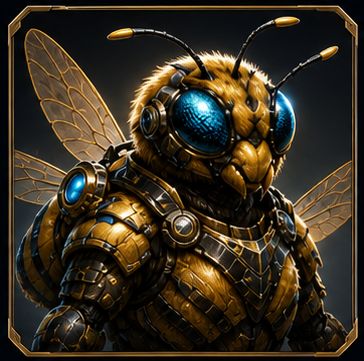
He builds like a hive under pressure. Buzz Stinger links small cells into useful geometry, then turns tidy little connections into a sudden swarm.
Hive architect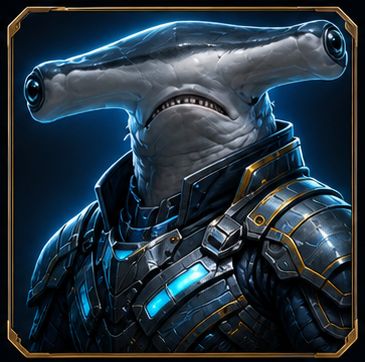
He patrols from the side, reading the board in wide arcs. Hamilton Marteau pressures odd angles, corners escape routes, and makes shallow positions feel like deep water.
Hammerhead tactician
She looks playful until she is already past the bow wave. Glacier Borealis glides through cold openings, slips beyond danger, and turns distance into advantage.
Arctic outrider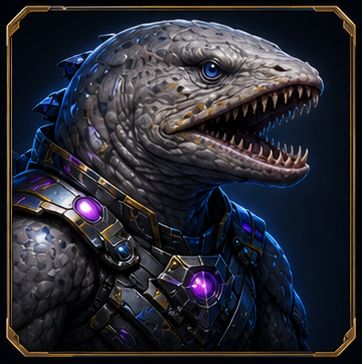
He is a gentle giant with a stone face and a reef guardian's patience. Fang looks fearsome enough to guard a cave, but he would rather take the safe bite and wait for the right opening.
Gentle giant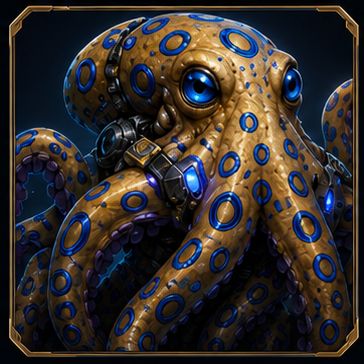
He is beautiful danger in a small blue warning ring. Octavius Indigo lays quiet traps, marks the safe-looking paths, and lets the opponent discover too late which sockets were poisoned.
Blue-ring trapper
He is the flash strike: brilliant, compact, and violently quick. Spectrum Pistolero fires at weak sockets, cracks positions open, and tries to win before anyone can pull the fight out of range.
Flash striker
She is the last tide. Silver Kahuna stays relaxed until the whole board begins to flow her way, then she swims beyond the striker's reach and closes the reef behind her.
Final tideUse the first action to create an opportunity and the second to claim it before anyone else can interfere.
Place tets to decide where the board can expand, or use corner tokens to block expansion from key faces.
A path is useful, but a sub or whole tet can outweigh several small local gains.
The strongest play often comes from seeing how today's tet changes the next several turns.
Refining the first Rabbots, testing personality logic, improving game records, and documenting how tokens, paths, subs, and whole-tet captures work.
Continuing toward richer human, Rabbot, and mixed-player matches, with better help, clearer records, and stronger Warren editing tools.